
Why Colouring Is the Self-Care Your Brain Has Been Begging For.
By Lola Olajide, Founder of Ruthy Michaels
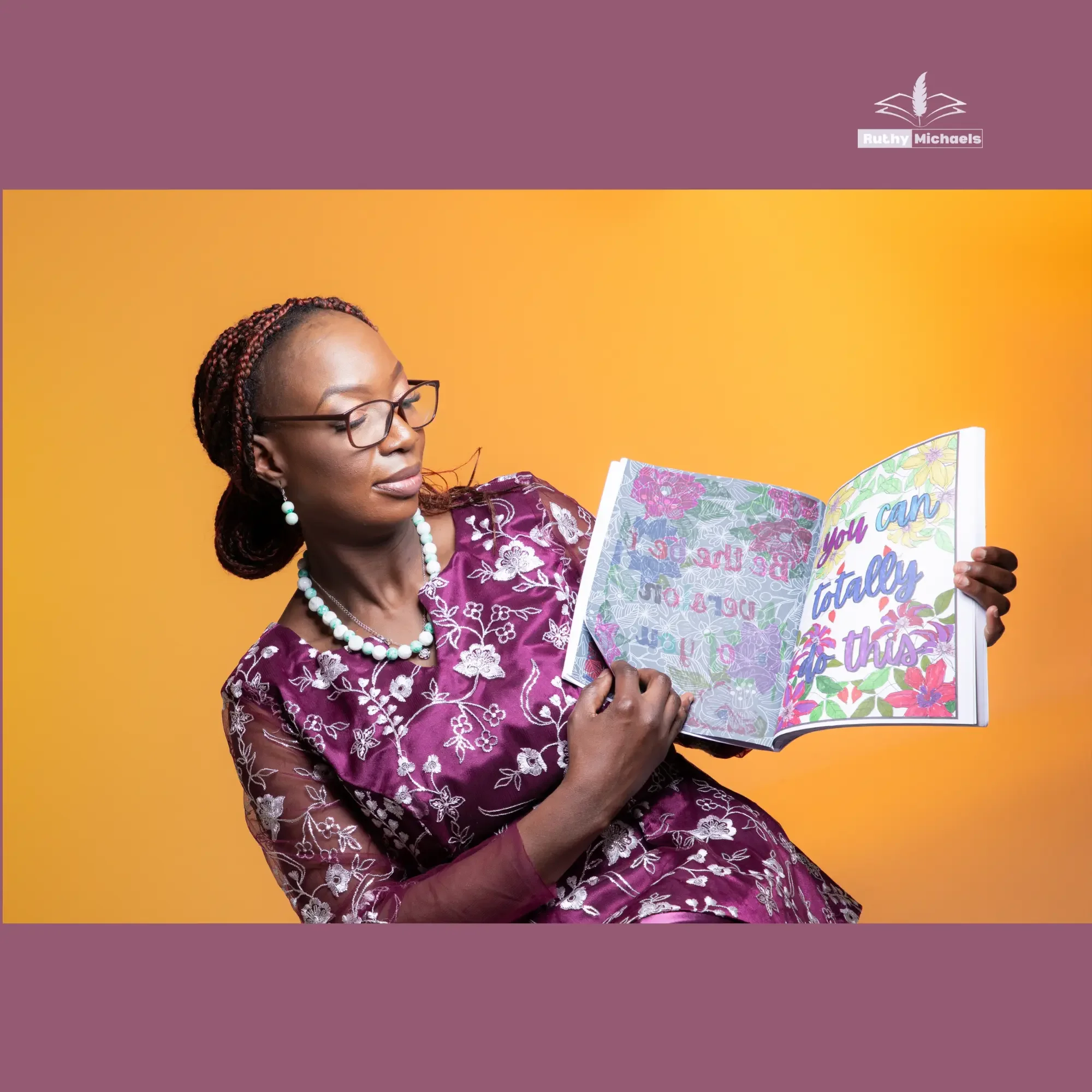
Lola Olajide, founder of Ruthy Michaels, sits peacefully holding open a colourful affirmations colouring book showing the page "You Can Totally Do This." She is wearing a deep purple floral dress and a teal beaded necklace with a warm orange background. The image is framed with a soft mauve border and the Ruthy Michaels logo in the top right corner.
There is a moment most busy mums know well. The children are finally in bed. The kitchen is almost tidy. You sit down — and instead of feeling peaceful, your brain immediately hands you a list. The unanswered messages. Tomorrow's school run. The thing you forgot to do last Tuesday.
You are exhausted, but you cannot switch off.
What if the answer was not another app, another breathing exercise, or another early night that never happens, but something as simple as picking up a pencil and adding colour to a page?
This is not about being creative. It is not childish. It is science. And your brain has been asking for it.
Colouring Quiets the Stress Centre of Your Brain
Inside your brain sits a small, almond-shaped structure called the amygdala. Its job is to detect threats and trigger your stress response, the racing heart, the anxious thoughts, the sense that something is wrong even when nothing is.
When you are overloaded, the amygdala fires constantly. It cannot tell the difference between a genuine emergency and an overflowing inbox.
Research from neurologists and psychologists has shown that colouring activates the prefrontal cortex, the rational, calm, creative part of your brain, while simultaneously reducing amygdala activity. In simple terms, colouring tells your brain it is safe to relax.
It is one of the few activities that is absorbing enough to interrupt anxious thought patterns, but gentle enough to actually feel restful.
It Mimics the Effects of Meditation, Without the Pressure to Clear Your Mind
Many people struggle with traditional meditation because the instruction to "clear your mind" feels impossible when your mind will not cooperate.
Colouring offers what psychologists call active mindfulness: your attention is gently anchored to what your hand is doing, what colour you are choosing, what shape you are filling. You are present without having to force it.
A 2005 study published in Art Therapy: Journal of the American Art Therapy Association found that colouring mandala patterns significantly reduced anxiety in participants. More recent research continues to support colouring as an accessible, low-barrier mindfulness practice, no training, no app, no subscription required.
It Gives Your Nervous System a Break From Decision Fatigue
By the end of a typical day, a mother has made hundreds of small decisions. What to feed everyone. Who needs what? What can wait and what cannot. This relentless decision-making exhausts the prefrontal cortex and leaves you feeling mentally drained even when your body has not moved.
Colouring is one of the rare activities in which the decisions are genuinely low-stakes. Which colour? How dark? Where to start? These small, pleasant choices re-engage your brain without depleting it. It is rest that feels like doing something, which, for many women, is the only kind of rest that actually works.
It Creates a Ritual of Permission
One of the most underrated benefits of colouring is not neurological; it is psychological. Sitting down with a colouring book is a physical signal to yourself that this time is yours.
For mothers and carers who spend most of their day in service of others, giving yourself a structured, visible activity — one that has a clear beginning and a page you can look at when you are done, creates a sense of completion and self-worth that scrolling through a phone simply does not.
It says: I matter enough to have five minutes that are just mine.
It Is One of the Most Accessible Forms of Self-Care Available
You do not need to book anything. You do not need to leave the house. You do not need to be good at art or have any previous experience. You do not need to spend much money.
A colouring book and a set of pencils can live on your kitchen table, in your bag, or beside your bed. It works in ten minutes or forty. It works when the children are napping or when you are sitting in the car before the school run.
That accessibility is not a small thing. It is the reason colouring works when other self-care practices do not: you will actually do it.
Frequently Asked Questions
Can colouring reduce anxiety? Yes. Multiple studies support the use of colouring as an effective tool for reducing anxiety, particularly when designs include repetitive patterns such as mandalas or geometric shapes. The repetitive, focused motion calms the nervous system and reduces the mental chatter associated with anxious thinking. It is not a replacement for professional support when needed, but it is a genuinely effective daily tool.
How long do I need to colour to feel calmer? Research suggests that even 10 to 15 minutes of focused colouring can produce a measurable reduction in stress. You do not need a long session to feel the benefit. Many people notice a shift in mood within the first few minutes as their attention narrows and their breathing slows naturally.
Is adult colouring just a trend? The mainstream popularity of adult colouring books peaked around 2015–2016, but the therapeutic use of art and colouring predates that entirely. Art therapists have used structured colouring activities with adults since at least the early twentieth century, when Carl Jung used mandala drawing with his patients. The science behind why it works has only grown stronger.
Do I need to be artistic to benefit from colouring? No. The benefit comes from the process, not the result. There is no right or wrong way to colour a page. The act of choosing colours, staying within (or outside) lines, and being present with a page is where the value lies — not in producing something gallery-worthy.
Can children benefit from colouring too? Absolutely. Colouring supports children's fine motor development, concentration, and emotional regulation. For children who struggle to express their feelings in words, a colouring page can create a calm, safe space that naturally opens conversation. It is one of the reasons therapeutic colouring books for children are so effective.
Ready to Give Your Brain the Reset It Deserves?
If this post has made you want to pick up a pencil, you are in exactly the right place.
At Ruthy Michaels, every colouring book is designed with your wellbeing at the centre, whether you are a mother looking for five quiet minutes, a woman navigating a stressful season, or a child who needs a calm and confidence-building activity.
[Browse the full collection here] and find the book that is waiting for you.
You have been taking care of everyone else. It is time to take care of you. 🌸
"P.S. This topic is close to my heart, so much so that the Tameside Correspondent recently featured my story and why I started Ruthy Michaels. You can read it here: www.tamesidecorrespondent.co.uk/2026/06/09/dukinfield-mum-turns-personal-struggle-into-wellness-brand/
